
1. Getting the Concepts Right: “Rust” and “Corrosion” Are Not the Same Thing
Many people treat “rust” and “corrosion” as the same phenomenon, but the two actually differ in scope:
Rust: refers specifically to the iron oxide (Fe₂O₃·nH₂O) formed when iron and steel react with oxygen and water — that reddish-brown, loose, easily flaking layer of rust. The rust layer is porous and not dense; not only does it fail to block corrosion, it actually lets oxygen and water keep penetrating, so the rust keeps spreading into the interior of the metal until the whole piece of iron is “rusted through.”
Corrosion: is the general term for the degradation of a metal through chemical/electrochemical reactions with its environment; rust is just one such phenomenon (the corrosion of iron).
So, strictly speaking: titanium contains no iron matrix, so it cannot form iron oxide, and therefore “rusting” does not occur. However, as a chemically reactive metal, titanium does react with oxygen — but the result of that reaction is precisely to protect itself, rather than to rust.
2. Why Titanium “Doesn't Rust”: An Invisible Passive Film
Titanium is a reactive metal. The moment it is exposed to an oxygen-containing environment (air or water), its surface instantly oxidizes, forming an oxide film composed mainly of titanium dioxide (TiO₂). This film has three key characteristics, which are the secret to titanium's corrosion resistance:
Extremely thin yet extremely dense: the freshly formed passive film is only about 2–5 nanometers thick (less than one ten-thousandth of a hair), and its structure is dense and pore-free, barely conducts ions, and can effectively prevent corrosion reactions from occurring.
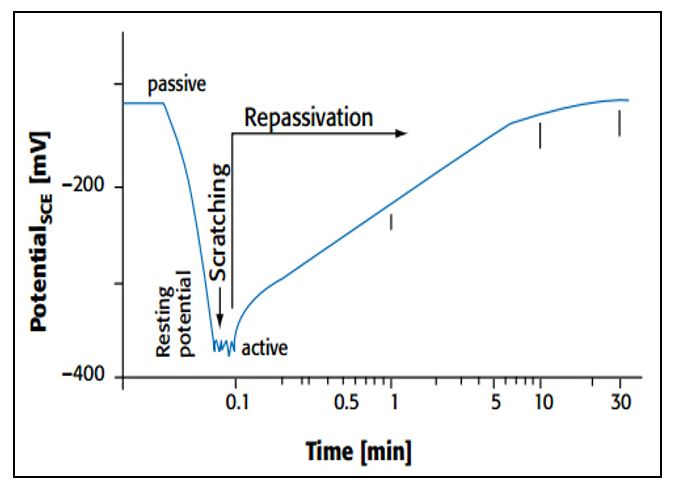
Forms extremely fast: in an oxygen-containing environment, this film can form spontaneously in under 100 microseconds.
Self-healing: this is the most obvious difference from iron rust. Once the film is scratched or worn through, as long as there is still oxygen in the environment (dissolved oxygen in air or water), it immediately re-forms on the exposed area — this process is called “repassivation.” Iron rust only keeps growing, whereas titanium's passive film “repairs itself the more it is damaged.”
Because of this, titanium does not “get worse the more it rusts” like iron; instead it maintains a self-protecting armor. The electrochemical “breakdown potential” is the most intuitive measure: the higher the potential, the harder it is for chloride ions to break through the passive film. In 37℃ Hank's physiological solution, the breakdown potentials of several common implant metals rank as follows:
Metal | Breakdown potential (37℃ Hank's solution) |
|---|---|
316L stainless steel | approx. 0.27 V |
Cobalt-chromium-molybdenum alloy (CoCrMo) | approx. 0.45 V |
Titanium alloy | approx. 2.0 V |
Pure titanium | approx. 2.4 V and above |
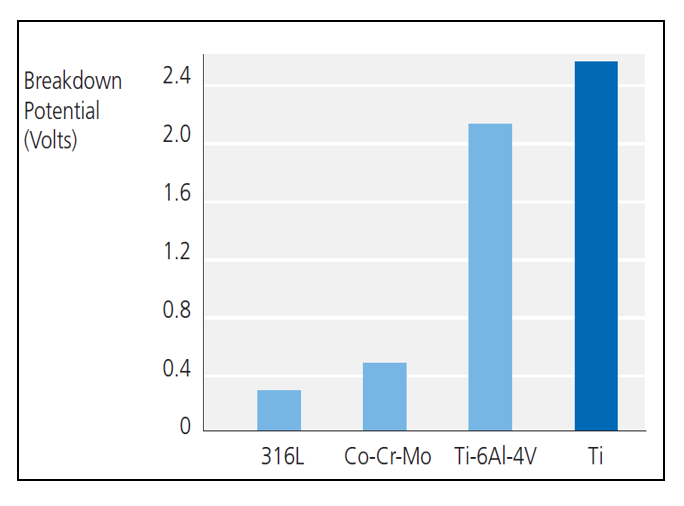
The breakdown potential of pure titanium and titanium alloys is an order of magnitude higher than 316L, meaning that in the same chloride-containing environment, titanium is much harder to break down by pitting; and even if the passive film is scratched, titanium can rapidly repassivate in physiological saline (0.9% NaCl). This is exactly why titanium can be safely implanted in the human body long-term.
3. Data Support: Titanium's Measured Performance in Seawater, Chlorides, and the Human Body
Titanium “does not rust” is not just a slogan; titanium's corrosion resistance is backed by decades of engineering measurements and electrochemical research:
Seawater: titanium's corrosion rate in seawater is so low as to be negligible, and it can withstand seawater environments up to 260℃ (500℉); commercially pure titanium Grade 2 remains fully corrosion-resistant in seawater below 315℃ (600℉).
Ultra-long-term service: titanium tubing exposed for 16 years in polluted, sulfide-containing seawater showed only slight surface discoloration with no signs of corrosion; titanium materials have provided more than 30 years of failure-free service in industries such as chemicals, refining, and seawater desalination.
Deep sea: titanium exposed long-term at depths greater than one mile below the sea surface produced no measurable corrosion; even with marine biological deposits attached to the surface, no pitting or crevice corrosion occurred.
The human body: human body fluids are rich in chloride ions, enzymes, and electrolytes, and are highly corrosive to metals, but titanium can maintain structural integrity long-term thanks to its TiO₂ passive film — this is exactly why orthopedic implants and surgical instruments can serve in the body for decades.
The common reason for all these performances is the same TiO₂ passive film — the more “oxidizing” the environment (such as seawater, nitric acid), the safer titanium performs.
4. Titanium vs. Stainless Steel vs. CoCrMo: One Table to Understand the Differences
In medical and industrial material selection, titanium is most often compared with 316L stainless steel and cobalt-chromium-molybdenum alloy. Combining corrosion resistance, density, stiffness, and other dimensions:
Comparison dimension | |||
|---|---|---|---|
Does it “rust”? | No (no iron matrix; relies on TiO₂ passive film) | Yes; prone to pitting/crevice corrosion in chlorides | Not easily, but chloride resistance is weaker than titanium |
Pitting resistance (breakdown potential) | Highest (titanium alloy approx. 2.0 V, pure titanium 2.4 V+) | Lowest (approx. 0.27 V) | Intermediate (approx. 0.45 V) |
Density | Light, approx. 4.4–4.5 g/cm³ | Heavy, approx. 7.9 g/cm³ | Heavy, approx. 8.3 g/cm³ |
Elastic modulus (stiffness) | Lower, approx. 100–114 GPa, closer to bone | High | Highest |
Magnetism | Non-magnetic (MRI compatible) | Mostly weakly magnetic/non-magnetic | Depends on composition |

Two points worth emphasizing: first, titanium's density is only about half that of stainless steel and cobalt-chromium-molybdenum alloy, and it is a non-magnetic material, naturally suited to lightweight and MRI-compatible scenarios; second, in terms of stiffness (elastic modulus), the ranking of these materials is exactly the opposite of corrosion resistance: cobalt-chromium-molybdenum alloy ≥ 316L > titanium alloy > pure titanium. Titanium's elastic modulus is closer to human bone tissue, which helps reduce the “stress shielding” effect after implantation — this is also one of the important reasons titanium is preferred in the field of orthopedic implant materials.
5. Is Titanium “Never Corroding”? Boundary Conditions You Must Know
I believe truly professional material selection does not focus only on titanium's advantages. Some boundary conditions must be taken into consideration at the design stage.
High-temperature crevice corrosion: this is titanium's primary limitation in seawater/chloride applications. In tight crevices and stagnant hot chloride environments, when the temperature exceeds about 70–80℃, pure titanium may undergo crevice corrosion. The solution is to switch to palladium-containing Grade 7 or molybdenum-containing Grade 12 and other grades, which can greatly raise the crevice-corrosion resistance temperature.
Fluoride-containing environments and strong reducing acids: fluoride ions at low pH will dissolve the TiO₂ passive film; strong reducing acids (such as inhibitor-free hydrochloric acid and sulfuric acid) will also destroy passivation. For example: Grade 2 titanium has a corrosion rate as high as about 800 mpy in boiling 3% hydrochloric acid, but as soon as about 100 ppm of an oxidizing inhibitor such as Fe³⁺ is added, the rate plummets to about 1 mpy — this shows that titanium's corrosion resistance highly depends on the oxidizing nature of the environment.
Dry high-temperature chlorine gas: titanium performs excellently in wet chlorine gas, but may react violently in dry chlorine gas, which requires special attention.
Galvanic corrosion: titanium has a relatively positive potential and is a “cathodic” metal; in a seawater galvanic couple it is itself almost not corroded, but it will accelerate the corrosion of the reactive metals connected to it (such as carbon steel, aluminum), so insulation or material matching is needed when joining dissimilar metals.
Not a wear-resistant material: titanium has strong corrosion resistance, but its hardness and wear resistance are not outstanding, and it is not suitable for directly making sliding-wear parts such as joint friction surfaces.
Sensitive to surface cracks: titanium and titanium alloys are relatively sensitive to surface defects; tiny scratches or even laser engraving may become fatigue crack sources, so load-bearing parts should avoid scratches or arbitrary engraving.
In one sentence: titanium is nearly invincible in “oxidizing, oxygen-containing, near-neutral” environments, but needs to be selected with caution in “reducing, oxygen-deficient, high-temperature crevice, fluoride-containing” environments.
6. Selecting Titanium Materials Requires Considering: Grades, Key Data, and Standards
After confirming titanium's corrosion boundaries, the real choice comes down to grade. SUNXIN can steadily supply full-grade titanium materials including Ti Grade 1/2/3/4, Ti-6Al-4V (Grade 5), Ti-6Al-4V ELI (Grade 23), and Ti-6Al-7Nb:
Pure titanium: has the best corrosion resistance among titanium materials (highest TiO₂ proportion), is easy to form, has good biocompatibility, and is suitable for dentistry, chemical engineering, marine, housings, and mesh. The higher the purity, the better the corrosion resistance; among them, Grade 2 has balanced overall performance and is the most commonly used, while Grade 4 has the highest strength and is a common choice for load-bearing implants such as dental ones.
Ti-6Al-4V (Grade 5): the most widely used titanium alloy, with high specific strength, widely used in medical, aerospace, and industrial load-bearing parts.
Ti-6Al-4V ELI (Grade 23): extra-low interstitial, higher toughness, the first choice for long-term implants.
Ti-6Al-7Nb: replaces vanadium with niobium, offers better biocompatibility, suitable for orthopedic implants.
Key mechanical data for the three main titanium alloys:
Grade | Density g/cm³ | Elastic modulus GPa | Hardness HV10 | Tensile strength MPa |
|---|---|---|---|---|
TC4 (Grade 5) | 4.42 | 110–114 | ≥260 | 930–1200 |
TC4 ELI (Grade 23) | 4.43 | 101–110 | 896–1100 | |
TC20 (Ti-6Al-7Nb) | 4.52 | 114 | 930–1300 |
When selecting materials, you must also pay attention to processing and acceptance standards: forgings commonly use YY 0117.1 (Grade 5), ASTM F620; castings commonly use YY 0117.2, ASTM F1108 (note: F1108 applies to Grade 5, not Ti-6Al-7Nb); the national standard GB/T 13810 is a comprehensive standard covering pure titanium, titanium alloys, ELI, and Ti-6Al-7Nb. It should be noted that GB/T 13810's requirement for hydrogen (H) content is stricter than some ISO series; although this helps reduce the risk of hydrogen embrittlement, it also brings higher costs and longer delivery times; while the ISO 5832 series of surgical-implant titanium materials has more than 30 years of clinical application history. Which set of standards to choose should be determined based on the regulations of the target market and customer requirements.
When purchasing metallic titanium, be sure to request the complete Mill Certificate, chemical composition, and full traceability documentation — this is the key to distinguishing a reliable manufacturer from a trading middleman.
FAQ
Does titanium rust?
No. “Rust” refers specifically to iron/steel forming loose iron oxide; titanium contains no iron matrix and does not rust. Titanium's surface instantly forms a dense, self-healing TiO₂ passive film, which instead protects the internal metal, so it is extremely corrosion-resistant in air, seawater, the human body, and other environments.
Does titanium corrode in seawater/saltwater?
It depends on the situation. In room-temperature seawater, titanium's corrosion rate is negligibly low; it can withstand seawater up to 260℃ and serves for decades without corrosion. Note that in stagnant hot chloride crevices at temperatures above about 70–80℃, pure titanium may undergo crevice corrosion, in which case Grade 7 or Grade 12 should be chosen.
Titanium vs. stainless steel — which is more corrosion-resistant?
In chloride-containing environments (such as seawater, body fluids), titanium is clearly more corrosion-resistant: its breakdown potential is far higher than 316L stainless steel, and its passive film can self-heal, unlike stainless steel which is prone to pitting and crevice corrosion.
Why can titanium be used as a material for medical implants?
Human body fluids are rich in chloride ions, enzymes, and electrolytes, and are very corrosive to metals, but titanium can maintain structural integrity long-term thanks to its TiO₂ passive film and repassivate after damage, which is also why it has become a mainstream material for orthopedic implants and surgical instruments.
Under what circumstances does titanium corrode?
Mainly these categories: fluoride-containing environments at low pH, inhibitor-free strong reducing acids (such as hydrochloric acid, sulfuric acid), dry high-temperature chlorine gas, and crevices in high-temperature stagnant chlorides. Avoiding them or selecting the grade accordingly is sufficient.
Is titanium attracted by magnets?
No, titanium is a non-magnetic material, so it is suitable for magnetically sensitive medical scenarios such as MRI.
Conclusion
Back to the original question — does titanium rust? No. It contains no iron and cannot form iron rust; what truly makes it “almost non-corroding” is that layer of TiO₂ passive film, a few nanometers thick, quickly forming, and able to self-repair. Because of this, titanium performs excellently in demanding environments such as seawater, chlorides, and the human body. At the same time, its boundary conditions must be noted: high-temperature crevices, fluorides, strong reducing acids, and dry chlorine gas — these are what must be considered during material selection.
SUNXIN specializes in metallic titanium and specialty alloys (also covering stainless steel, cobalt-based alloys, nickel-based alloys, tantalum alloys, and nickel-titanium memory alloy Nitinol), with products mainly serving the medical field (surgical instruments, orthopedic implants, covering trauma, spine, joints, sports medicine, cardiovascular, dental, etc.), and widely used in aerospace, industrial, and precision machinery manufacturing. Sunxin has passed ISO 9001 and ISO 13485 quality system certification, with customers in more than 40 countries and regions worldwide. We provide commercially pure titanium (Grade 1–Grade 4), Ti-6Al-4V (Grade 5), Grade 23 ELI, and Ti-6Al-7Nb and other grade titanium materials, with complete material certificates and full traceability documentation shipped with the goods (EN 10204 3.1, corresponding to ASTM F67/F136, ISO 5832, and other standards). If you are selecting titanium materials for corrosion resistance, lightweighting, or implant applications, welcome to contact us for samples, specification sheets, and material selection advice.