
Choosing between 316LVM stainless steel and titanium is not simply about deciding which metal is “better.” In medical device manufacturing, the better material is the one that fits the product’s function, risk level, mechanical load, manufacturing process, regulatory pathway, and target market expectations.
For manufacturers of orthopedic implants, dental components, surgical instruments, trauma fixation systems, medical wires, precision shafts, and implantable devices, this decision directly affects cost, machining efficiency, product performance, documentation, and customer trust.
Both 316LVM and titanium are widely used in the medical industry. Both can be suitable for demanding applications when produced under controlled standards and supplied with reliable traceability. But they are not interchangeable. A material that works well for a surgical guide wire may not be the right choice for a dental implant body. A metal that performs well in a long-term bone screw may be unnecessarily expensive for a temporary component or surgical tool.
This guide explains when to use 316LVM, when to use titanium, and how medical device manufacturers can make a more practical material decision before production begins.
What Is 316LVM?
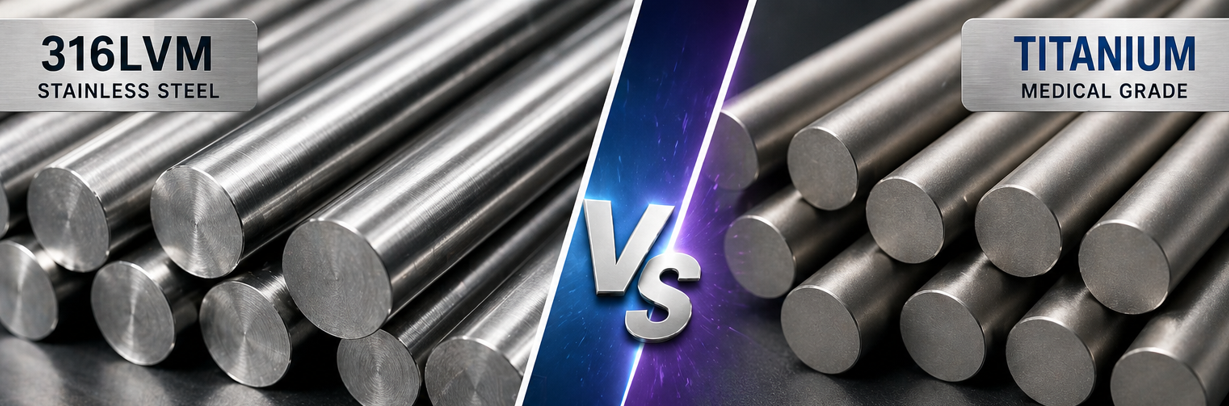
316LVM is a medical-grade version of 316L stainless steel. The name itself explains the material.
“316” refers to an austenitic stainless steel family containing chromium, nickel, and molybdenum. “L” means low carbon, which helps reduce the risk of intergranular corrosion. “VM” means vacuum melted, a process designed to improve cleanliness, reduce inclusions, and create more consistent metallurgical quality.
Compared with ordinary 316L stainless steel, 316LVM is produced with tighter control over purity and performance. This matters in medical manufacturing because small defects, inclusions, or inconsistent properties can affect fatigue life, surface quality, and product reliability.
316LVM is commonly used for surgical instruments, guide wires, orthopedic fixation components, dental tools, medical springs, precision shafts, pins, and some temporary implant-related products.
Its main advantages are practical: good strength, good stiffness, good polishability, mature processing methods, stable availability, and better cost control compared with titanium.
What Is Titanium?
Medical titanium usually includes two major categories: commercially pure titanium and titanium alloy.
Commercially pure titanium includes Grade 1, Grade 2, Grade 3, and Grade 4. These grades are valued for biocompatibility, corrosion resistance, and long-term stability in the body. Grade 4 is often selected when higher strength is needed among pure titanium grades.
Titanium alloy, especially Ti-6Al-4V ELI, also known as Grade 23, is widely used for orthopedic implants, spinal implants, bone screws, trauma plates, dental components, and other high-performance implantable devices.
Titanium is known for its excellent corrosion resistance, low density, high strength-to-weight ratio, and strong clinical acceptance. For permanent implants, especially dental and orthopedic products, titanium is often the preferred material.
The Core Difference Between 316LVM and Titanium
The most practical difference is this:
316LVM is usually chosen for strength, stiffness, cost efficiency, polishability, and manufacturing practicality. Titanium is usually chosen for long-term biocompatibility, corrosion resistance, lightweight performance, and premium implant applications.
This does not mean 316LVM is low-end. It also does not mean titanium is always the correct choice.
A surgical instrument manufacturer may not need titanium. A dental implant manufacturer usually should not choose stainless steel for the implant body. A producer of temporary fixation pins may choose 316LVM because it offers stiffness and cost advantages. A producer of long-term orthopedic implants may choose titanium because biological performance and patient comfort are more important.
Good material selection is not about choosing the most expensive metal. It is about matching the material to the real application.
Mechanical Properties: Strength, Stiffness, and Load Behavior
316LVM stainless steel offers good mechanical strength and high stiffness. This makes it useful when a part must resist bending, deformation, or flexing. In applications such as guide wires, surgical tools, shafts, and certain fixation components, stiffness can be an advantage.
Titanium has a lower elastic modulus than stainless steel. In simple terms, titanium is less stiff and behaves more similarly to bone. This can be useful in implant applications because it may reduce stress shielding, where a very stiff implant carries too much load and the surrounding bone carries too little.
However, titanium is not automatically stronger in every form. Commercially pure titanium has excellent biological performance, but its strength is lower than titanium alloy. Ti-6Al-4V ELI provides much higher strength and is often used when mechanical performance is critical.
So the real comparison should not only be “316LVM vs titanium.” Manufacturers should compare the exact grades:
316LVM vs CP Titanium Grade 2
316LVM vs CP Titanium Grade 4
316LVM vs Ti-6Al-4V ELI Grade 23
Each comparison may lead to a different decision.
Corrosion Resistance: Where Titanium Has a Strong Advantage
Both 316LVM and titanium have corrosion resistance, but titanium generally performs better in long-term biological environments.
316LVM contains molybdenum, which improves resistance to pitting and crevice corrosion compared with many standard stainless steels. With proper surface treatment, cleaning, and passivation, it can perform well in many medical applications.
However, stainless steel still depends on its passive chromium oxide layer. In chloride-rich environments, crevices, or poor surface conditions, stainless steel may face a higher corrosion risk than titanium.
Titanium forms a stable titanium oxide layer on its surface. This oxide layer gives titanium excellent corrosion resistance in the human body. That is one reason titanium is widely used in dental implants, orthopedic implants, spinal implants, and other long-term implantable devices.
For short-term use, surgical instruments, temporary fixation, and cost-sensitive medical parts, 316LVM may be suitable. For permanent implants or high-risk biological applications, titanium often has the stronger case.
Biocompatibility: Why Application Time Matters
Titanium is widely valued for biocompatibility. It is commonly used in dental implants, bone screws, trauma plates, spinal cages, and maxillofacial implants. When a device will stay inside the body for a long time, titanium is often preferred because of its corrosion resistance and biological acceptance.
316LVM can also be used in medical and implant-related applications, but it contains nickel. In many approved applications, this is acceptable. However, for markets or patients with higher sensitivity concerns, titanium may be more attractive.
This is especially important in dental implant manufacturing. Dental implant buyers, clinics, and distributors generally expect implant bodies to be made from titanium or titanium alloy. Even if stainless steel has medical uses, it is not the normal choice for a modern dental implant fixture.
Weight Difference: Titanium Is Much Lighter
Titanium is significantly lighter than stainless steel. This difference may not matter much for very small parts, but it becomes more important for larger implants and devices.
For orthopedic plates, spinal systems, dental implant systems, and long-term implantable components, lower weight can improve patient comfort and product appeal. Titanium’s strength-to-weight ratio is one of its biggest advantages.
For small surgical tools, guide wires, pins, or precision parts, weight may not matter enough to justify titanium’s higher cost. In these cases, 316LVM may remain the more practical choice.
Machining and Production Considerations
From a manufacturing perspective, 316LVM is often easier to process than titanium. Many factories are already familiar with machining stainless steel. It can still work-harden and requires proper cutting tools, coolant, and parameters, but the process is generally more predictable.
Titanium is more difficult to machine. It has low thermal conductivity, meaning heat stays near the cutting area. It can cause tool wear, galling, and surface quality problems if not processed correctly. Machining titanium often requires better tools, suitable coolant, slower speeds, and careful process control.
This affects total production cost. Buyers should not only compare raw material price per kilogram. They should also consider tool consumption, cycle time, scrap rate, surface finishing, cleaning, inspection, and delivery time.
For manufacturers with limited titanium machining experience, switching from stainless steel to titanium can create unexpected production challenges.
Cost and Supply Chain
316LVM is usually more economical than titanium. Raw material cost is generally lower, machining is often easier, and many sizes are easier to source. For high-volume medical parts, surgical tools, and cost-sensitive components, this can make 316LVM very attractive.
Titanium is more expensive, especially medical-grade titanium alloy such as Ti-6Al-4V ELI. It also requires stricter machining control and careful documentation. But in high-value implant applications, the added cost is often justified by performance, market acceptance, and long-term reliability.
For B2B buyers, the decision should include more than price. They should consider material grade, standard requirements, size availability, MOQ, lead time, certificate traceability, machining difficulty, surface finish requirements, application risk, and customer expectations.
This is where supplier experience matters. For example, SUNXIN supplies medical stainless steel and titanium materials such as bars, rods, tubes, wires, and customized sizes for medical device manufacturers. For B2B buyers comparing 316LVM and titanium, a reliable supplier should help match the material grade to the real application, not simply quote the cheapest available option.
When to Use 316LVM
316LVM is a good choice when the product needs medical-grade stainless steel with good cleanliness, strength, stiffness, polishability, and cost control.
It is commonly suitable for surgical instruments, orthopedic guide wires, temporary fixation components, dental instruments, precision medical shafts, medical springs, small machined parts, pins, and components requiring polishing.
316LVM is especially useful when the component does not need to remain in the body permanently or when the product design already accepts implant-grade stainless steel.
It is also a strong choice when stiffness is needed. Compared with titanium, stainless steel is more rigid. For guide wires, tools, and certain precision parts, this can improve handling and performance.
Manufacturers may choose 316LVM when they need a balance of performance, cost, and processing stability. In many B2B projects, especially where volume production matters, this balance is more important than choosing the most advanced material on paper.
When to Use Titanium
Titanium is the better choice when long-term implantation, corrosion resistance, biocompatibility, and lightweight performance are key requirements.
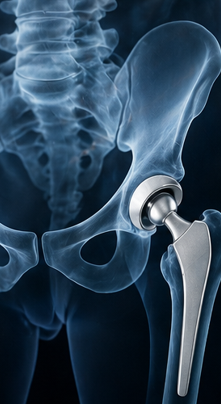
It is commonly suitable for dental implants, dental abutments, orthopedic bone screws, trauma plates, spinal implants, maxillofacial implants, joint reconstruction components, and permanent implantable devices.
Commercially pure titanium is often chosen when excellent biocompatibility and corrosion resistance are the main priorities. Ti-6Al-4V ELI is often chosen when higher strength is needed.
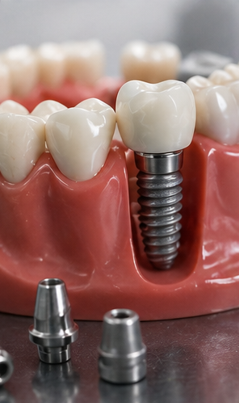
For dental implant manufacturers, titanium is usually the standard material for implant bodies. For orthopedic manufacturers, both stainless steel and titanium may be used depending on product type, fixation time, mechanical loading, surgeon preference, and market demand.
316LVM vs Titanium Comparison Table
Factor | 316LVM Stainless Steel | Titanium / Titanium Alloy |
|---|---|---|
Main advantage | Strength, stiffness, cost control | Biocompatibility, corrosion resistance, lightweight |
Typical standards | ASTM F138, ISO 5832-1 | ASTM F67, ASTM F136, ISO 5832 series |
Density | Heavier | Lighter |
Corrosion resistance | Good | Excellent |
Biocompatibility | Good for suitable applications | Excellent for long-term implants |
Machining | Generally easier | More difficult |
Cost | Lower | Higher |
Stiffness | Higher | Lower, closer to bone |
Typical use | Instruments, guide wires, temporary parts | Dental implants, orthopedic implants, spinal systems |
Best fit | Cost-effective precision medical parts | Permanent implantable devices |
A Practical Decision Framework for Manufacturers
Before choosing between 316LVM and titanium, manufacturers should ask five practical questions.
First, will the device stay inside the body long term? If yes, titanium should usually be considered first, especially for dental, orthopedic, and spinal implants.
Second, does the product need high stiffness? If stiffness and rigidity are important, 316LVM may be better. If lower modulus and bone-like behavior are preferred, titanium may be better.
Third, is the product cost-sensitive? For high-volume components, 316LVM can offer strong cost advantages. For premium implants, titanium’s higher cost may be acceptable.
Fourth, what does the customer or market expect? Dental implant customers usually expect titanium. Surgical instrument buyers may prefer stainless steel because of cost, hardness, polishability, and familiar performance.
Fifth, can the factory process the material reliably? Titanium requires more controlled machining. If the factory does not have experience with titanium, production cost and scrap rate may increase.
Common Mistakes Buyers Make
One common mistake is choosing titanium simply because it sounds more advanced. Titanium is excellent, but not every medical component needs it.
Another mistake is choosing 316LVM only because it is cheaper. If the product is a permanent implant where titanium is expected, saving on raw material may cause bigger problems later.
A third mistake is comparing only material price. The real cost includes machining time, tool wear, polishing, cleaning, inspection, packaging, and documentation.
A fourth mistake is ignoring certificates. Medical device manufacturers should request material certificates, heat numbers, chemical composition, mechanical properties, and applicable standards.
A fifth mistake is using a general industrial grade when a medical-grade material is required. In medical manufacturing, traceability and standard compliance are not optional details. They are part of the product’s quality foundation.
This is why working with an experienced material supplier is important. SUNXIN supports customers with medical stainless steel and titanium materials, including 316LVM, titanium Grade 2, titanium Grade 4, and Ti-6Al-4V ELI. For manufacturers, the value is not only material supply, but also helping reduce selection risk before production begins.
How B2B Buyers Should Evaluate Material Suppliers
For B2B medical material purchasing, the supplier should be evaluated beyond price. A low quotation is not useful if the material cannot meet the required standard, size tolerance, surface condition, or documentation requirement.
A reliable supplier should be able to provide clear material grades, traceable certificates, stable dimensions, suitable surface quality, and experience with medical applications. Buyers should also check whether the supplier can support bars, rods, tubes, wires, sheets, or customized sizes according to the project.
For manufacturers developing new products, early communication with the supplier can reduce risk. Sometimes a small change in material grade, diameter, tolerance, or surface condition can improve machining efficiency and reduce waste.
This is particularly important for 316LVM and titanium because both materials may look similar in quotation documents, but their production behavior is very different. A supplier familiar with medical device manufacturing can help buyers avoid wrong-grade selection, unsuitable tolerances, and unnecessary cost increases.
FAQ
1. Is 316LVM implant grade?
Yes. 316LVM is widely used as a medical-grade stainless steel and is commonly associated with implant-related standards such as ASTM F138 and ISO 5832-1. However, suitability depends on device design, implantation time, regulatory requirements, and market approval.
2. Is titanium always better than 316LVM?
No. Titanium is better for many long-term implant applications, but 316LVM may be better for instruments, wires, precision shafts, temporary fixation parts, and cost-sensitive medical components.
3. Which material is better for dental implants?
Titanium is usually the better choice for dental implant bodies because of its biocompatibility, corrosion resistance, and strong clinical acceptance.
4. Which material is easier to machine?
316LVM is generally easier to machine than titanium. Titanium requires stricter cutting control, better tools, and more attention to heat management.
5. Which material is cheaper?
316LVM is usually cheaper than titanium in both raw material and processing cost. However, total cost depends on size, tolerance, surface finish, order quantity, and certification requirements.
6. Can 316LVM be used for surgical instruments?
Yes. 316LVM can be used for many surgical instruments and precision medical components where corrosion resistance, cleanliness, strength, and polishability are required.
7. What titanium grade is used for medical implants?
Common titanium materials include commercially pure titanium Grade 2 and Grade 4, as well as Ti-6Al-4V ELI Grade 23 for higher-strength implant applications.
8. Why do some manufacturers still choose stainless steel instead of titanium?
Manufacturers may choose stainless steel because it offers good strength, high stiffness, mature machining behavior, lower cost, and stable supply. For instruments, temporary components, and some precision parts, these advantages can be more important than titanium’s lightweight performance.
9. How should buyers choose between 316LVM and titanium?
Buyers should consider application time, mechanical load, corrosion risk, biocompatibility requirements, machining capability, target market expectations, and total production cost. The decision should be based on the device’s real use, not only on material price.
10. How should B2B buyers choose a supplier?
Buyers should check whether the supplier can provide stable quality, traceable certificates, suitable sizes, medical-grade standards, and experience with medical device customers.
Conclusion
316LVM and titanium are both valuable medical materials, but they solve different problems.
Choose 316LVM when you need a clean, strong, stiff, cost-effective material for surgical instruments, guide wires, temporary fixation parts, and precision medical components.
Choose titanium when you need excellent biocompatibility, long-term corrosion resistance, lightweight performance, and strong acceptance for permanent implantable devices.
For manufacturers, the right decision is not based only on material price. It should consider product function, clinical use, machining process, documentation, and customer expectations.
SUNXIN provides medical-grade stainless steel and titanium materials for device manufacturers, including bars, rods, tubes, wires, and customized sizes. Whether your project requires 316LVM or titanium, the best starting point is always the same: understand the application first, then choose the material that supports safe, stable, and efficient production.
Related News
-
 Introduction: Why This Comparison Matters More Than You ThinkWhen sourcing stainless steel for industrial, medical, or manufacturing applications, one of the most common—and critical—decisions buyers face is choosing between 304 and 316 stainless steel.At first glance, they look nearly identical. Bo