
Introduction
Implant corrosion is one of the most misunderstood yet critical issues in modern medical device manufacturing. While metallic implants—especially those made from titanium alloys and stainless steels—are widely recognized for their corrosion resistance, they are not immune to degradation.
For manufacturers, corrosion is not just a material science problem; it directly affects product longevity, clinical performance, regulatory compliance, and ultimately brand reputation. For distributors and OEM buyers, understanding corrosion mechanisms is essential when evaluating suppliers and ensuring long-term reliability.
This article goes beyond surface-level explanations. It explores root causes, material behaviors, environmental triggers, testing standards, and real-world implications, offering a practical framework for B2B decision-makers.
What Is Implant Corrosion?
Implant corrosion refers to the electrochemical degradation of metallic materials when exposed to physiological environments. The human body is a highly aggressive medium—rich in electrolytes, proteins, fluctuating pH levels, and mechanical stress—all of which can accelerate corrosion processes.
Unlike industrial corrosion, implant corrosion is more complex because it involves:
Biochemical interactions
Mechanical loading (fretting, fatigue)
Long-term exposure (years or decades)
Primary Causes of Implant Corrosion
1. Electrochemical Reactions in the Body
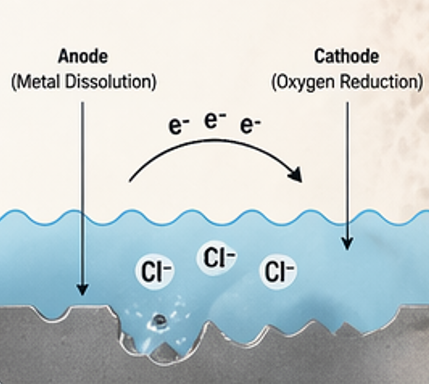
At its core, corrosion is an electrochemical process. When an implant is placed in the body, it is surrounded by fluids containing ions such as chloride (Cl⁻), which are particularly aggressive toward metals.
Key mechanisms include:
Anodic dissolution (metal atoms lose electrons)
Cathodic reactions (oxygen reduction)
Even highly resistant materials like titanium rely on a thin oxide layer (TiO₂) for protection. Once this layer is compromised, corrosion can initiate.
2. Breakdown of Passive Oxide Layers
Most implant-grade metals (e.g., titanium, stainless steel) depend on passivation layers for corrosion resistance.
However, these layers can be disrupted by:
Mechanical damage during implantation
Micro-motion between components
Chemical attack from low pH environments
For example, in titanium alloys, once the oxide film is damaged, localized corrosion can occur before repassivation happens.
3. Fretting and Mechanical Wear
Corrosion is rarely purely chemical in implants—it is often tribocorrosion, a combination of wear and corrosion.
Common in:
Abutment–implant interfaces
Modular implant systems
Micro-movements lead to:
Removal of protective oxide layers
Exposure of fresh metal surfaces
Accelerated corrosion cycles
This is particularly relevant for OEM buyers sourcing components with tight tolerances.
4. Galvanic Corrosion (Dissimilar Metals)
When two different metals are in contact within an electrolyte (like body fluid), galvanic corrosion can occur.
Examples include:
Titanium implants with stainless steel screws
Mixed alloy systems in modular designs
The less noble metal corrodes faster, leading to:
Material degradation
Ion release
Structural weakening
5. Crevice Corrosion in Confined Spaces
Crevice corrosion occurs in small gaps where fluid exchange is limited, such as:
Threaded connections
Implant–abutment junctions
Inside these crevices:
Oxygen levels drop
pH becomes acidic
Chloride ions concentrate
This creates an aggressive microenvironment that accelerates corrosion even in otherwise stable materials.
6. Biological Factors
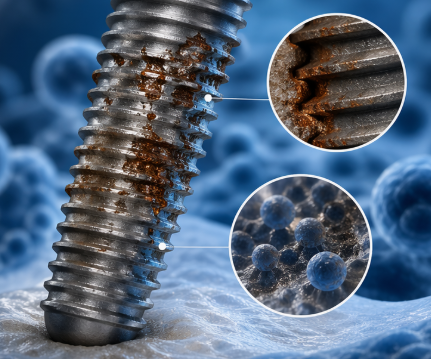
The human body actively contributes to corrosion:
Proteins can bind to metal ions
Cells (e.g., macrophages) release reactive species
Inflammation lowers local pH
In infected environments, corrosion rates can increase significantly.
7. Surface Defects and Manufacturing Quality
Corrosion resistance is highly dependent on surface integrity.
Critical factors include:
Surface roughness
Microcracks
Contaminants (iron particles, residues)
Poor finishing processes can create initiation sites for corrosion. This is why advanced manufacturers invest heavily in:
Precision machining
Controlled surface treatments
Strict cleaning protocols
Material Comparison: Corrosion Resistance in Implants
Material | Corrosion Resistance | Key Risk |
|---|---|---|
Titanium (Grade 4, Ti-6Al-4V) | Excellent | Fretting corrosion |
Stainless Steel (316L) | Moderate | Pitting corrosion |
High | Ion release concerns | |
Titanium Alloys (Ti-6Al-7Nb) | Excellent | Cost and processing complexity |
Insight:
Titanium remains dominant not because it is corrosion-proof, but because it forms a self-healing oxide layer that performs well in dynamic biological environments.
Testing and Standards for Corrosion Resistance
To ensure reliability, implant materials must undergo rigorous testing:
ASTM F2129 – Cyclic potentiodynamic polarization
ISO 10271 – Corrosion testing in dentistry
ASTM F746 – Pitting and crevice corrosion
These tests simulate body conditions to evaluate:
Breakdown potential
Repassivation behavior
Ion release rates
For B2B buyers, requesting test reports and compliance documentation is essential when evaluating suppliers.
Real-World Impact of Implant Corrosion
Corrosion is not just a theoretical issue—it has real consequences:
1. Mechanical Failure
Loss of structural integrity can lead to implant fracture.
2. Biological Reactions
Metal ion release may cause:
Inflammation
Allergic reactions
Tissue damage
3. Aesthetic and Functional Issues
In dental implants, corrosion can affect:
Color stability
Surface integrity
Osseointegration
How Manufacturers Can Reduce Corrosion Risk
Material Selection
Choosing high-purity, medical-grade alloys is the first step.
Surface Engineering
Advanced treatments include:
Anodization
Passivation
Sandblasting + acid etching (SLA)
Precision Manufacturing
Reducing micro-gaps and improving fit minimizes crevice and fretting corrosion.
Quality Control Systems
Strict inspection ensures:
No contamination
Consistent surface finish
Compliance with international standards
In practice, experienced manufacturers—such as SUNXIN—focus on process consistency and metallurgical control, which are often more critical than the base material itself.
What B2B Buyers Should Look For
When sourcing implants or raw materials, consider:
Verified material certifications (e.g., ASTM, ISO)
Surface treatment documentation
Corrosion test data
Manufacturing consistency
Instead of focusing solely on price, evaluating long-term performance risks can prevent costly downstream issues.
Frequently Asked Questions (FAQ)
1. Can titanium implants corrode?
Yes, although titanium is highly resistant, it can corrode under conditions such as fretting, low pH, or mechanical damage.
2. What is the most dangerous type of corrosion for implants?
Localized corrosion (pitting or crevice) is particularly dangerous because it can lead to sudden failure.
3. Does surface roughness increase corrosion risk?
It can. While rough surfaces improve osseointegration, they may also create microenvironments where corrosion initiates.
4. How important is supplier quality in preventing corrosion?
Extremely important. Manufacturing defects are one of the leading contributors to premature corrosion.
5. Are newer alloys better than traditional ones?
Not always. Performance depends on processing, finishing, and quality control, not just composition.
Conclusion
Implant corrosion is a multi-factorial phenomenon involving material science, mechanical engineering, and biological interaction. No material is entirely immune, but the risk can be significantly reduced through proper design, manufacturing, and quality control.
For manufacturers and B2B buyers, the key takeaway is clear:
Corrosion resistance is not just about choosing the right alloy—it is about controlling the entire production ecosystem.
Suppliers that demonstrate consistency, testing transparency, and process discipline will always outperform those competing on cost alone.