
Introduction
Titanium has long been regarded as the gold standard for medical and dental implants. Its excellent biocompatibility, corrosion resistance, and mechanical strength make it the preferred choice across orthopedic and dental applications. Yet despite its strong reputation, titanium implants are not immune to failure.
For manufacturers, distributors, and procurement professionals, understanding why titanium implants fail is not just a technical concern—it is a strategic one. Failure mechanisms influence product design, material selection, supplier evaluation, and ultimately, brand credibility in a highly regulated market.
This article takes a materials-first, engineering-level look at titanium implant failure. Rather than repeating common surface-level explanations, we will break down the interplay between metallurgy, surface engineering, and clinical conditions, offering insights that are directly actionable for B2B stakeholders.
What Does “Titanium Implant Failure” Actually Mean?
Before analyzing causes, it’s important to define failure precisely.
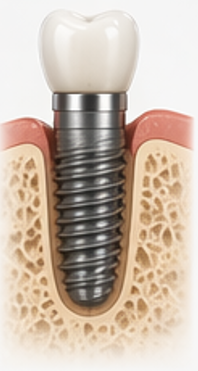
Titanium implant failure can be categorized into:
Mechanical failure – fracture, deformation, or fatigue
Biological failure – lack of osseointegration or bone loss
Chemical failure – corrosion, ion release, or surface degradation
Functional failure – implant remains intact but fails clinically
Most failures are not caused by a single factor. Instead, they result from multi-factor interactions between material properties, manufacturing quality, and clinical environment.
1. Material Composition and Metallurgical Defects
The Hidden Risk in “Titanium”
Not all titanium is equal. Commercially pure titanium (CP Ti) and titanium alloys such as Ti-6Al-4V differ significantly in:
Grain structure
Oxygen content
Fatigue resistance
Elastic modulus
Even within the same grade, inconsistencies in melting, forging, or heat treatment can introduce:
Inclusions
Microvoids
Segregation zones
These microscopic imperfections often become crack initiation sites, especially under cyclic loading.
Why It Matters for B2B Buyers
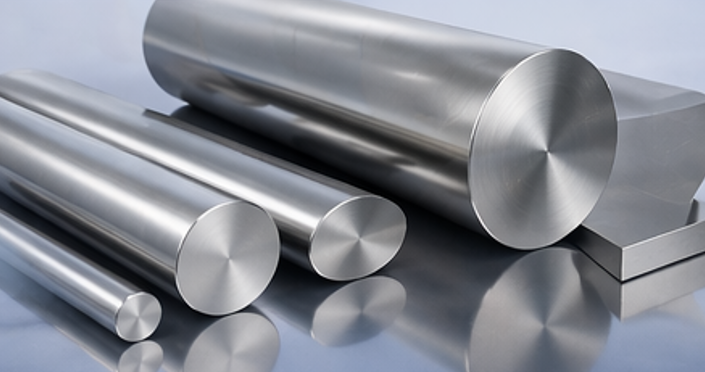
Low-cost sourcing often prioritizes price over metallurgical consistency. However, material purity and traceability are critical for long-term implant reliability.
High-quality suppliers typically implement:
Vacuum melting (VAR or EBM)
Strict composition control
Ultrasonic testing for internal defects
This is where experienced material manufacturers—such as those specializing in medical-grade titanium like 舜鑫—tend to differentiate themselves, not by marketing claims, but by process stability and documentation transparency.
2. Surface Integrity and Treatment Issues
Surface: The Real Interface with Biology
While bulk material properties matter, implant success is heavily influenced by surface characteristics, including:
Roughness (Ra values)
Oxide layer thickness
Surface energy
Contaminant presence
Improper surface treatment can lead to:
Poor osseointegration
Increased bacterial adhesion
Accelerated corrosion
Common Surface-Related Failures
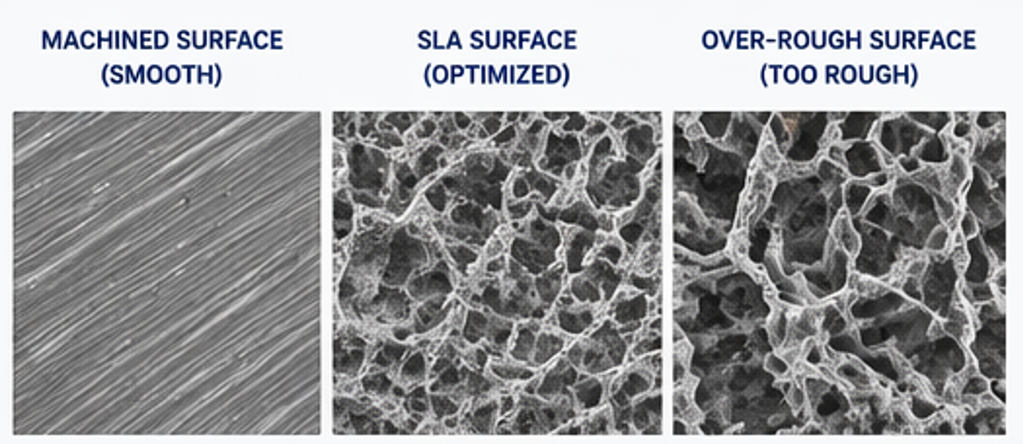
Overly smooth surfaces → insufficient bone anchoring
Excessively rough surfaces → bacterial colonization risk
Residual blasting media → inflammatory reactions
Unstable oxide layers → ion release
Manufacturing Insight
Surface treatments such as:
Sandblasting + acid etching (SLA)
Anodization
Plasma spraying
must be tightly controlled. Even small deviations in acid concentration or blasting pressure can alter clinical outcomes.
A reliable materials partner doesn’t just supply titanium—they ensure surface compatibility with downstream processing.
3. Corrosion and Electrochemical Degradation
Titanium Is Corrosion-Resistant—But Not Corrosion-Proof
Titanium naturally forms a passive oxide layer (TiO₂), which protects it from corrosion. However, under certain conditions, this layer can break down.
Key Corrosion Mechanisms:
Crevice corrosion (tight implant interfaces)
Galvanic corrosion (mixed metals)
Fretting corrosion (micro-movements under load)
The Oral Environment Challenge
In dental applications, implants face:
Saliva with fluctuating pH
Bacterial biofilms
Temperature changes
Mechanical loading cycles
These factors can destabilize the oxide layer, leading to:
Titanium ion release
Inflammation
Bone resorption
Strategic Takeaway
Corrosion resistance depends not only on titanium grade but also on:
Surface finish quality
Microstructural uniformity
Absence of contaminants
Material consistency from upstream suppliers plays a decisive role here.
4. Mechanical Overload and Fatigue Failure
Cyclic Stress: The Silent Killer
Implants rarely fail from a single overload event. Instead, they fail due to fatigue—repeated stress over time.
Factors contributing to fatigue failure include:
Poor implant design
Misaligned loading
Insufficient diameter or thickness
Material defects
Microcracks and Propagation
Even high-strength titanium alloys can develop microcracks. Once initiated, these cracks propagate under cyclic loads until catastrophic failure occurs.
Design vs. Material Responsibility
There is often a misconception that implant failure is purely a design issue. In reality:
Design determines stress distribution
Material quality determines crack resistance
A small variation in grain size or inclusion content can significantly reduce fatigue life.
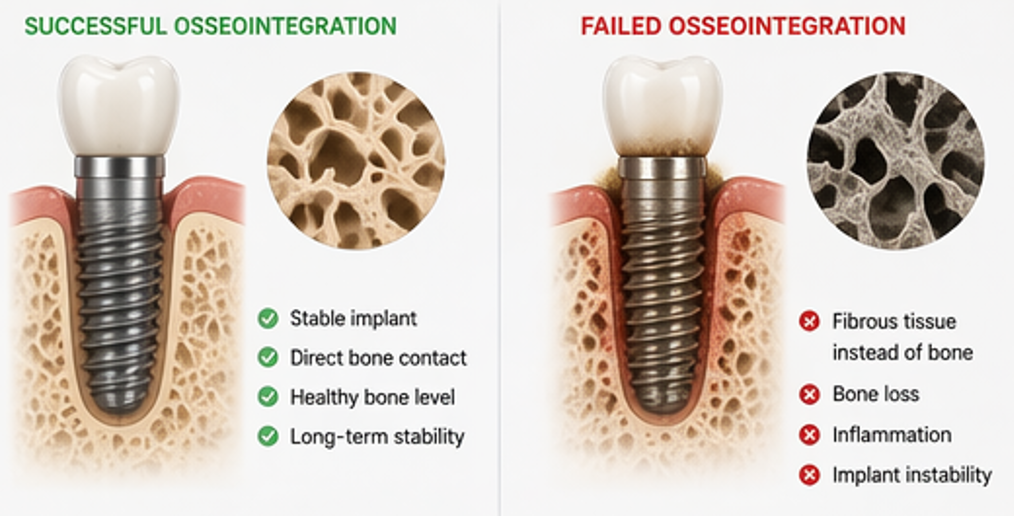
5. Osseointegration Failure
When Biology Rejects Engineering
Osseointegration is the process by which bone bonds with the implant surface. Failure can occur due to:
Poor surface properties
Micromotion during healing
Infection
Patient-related factors (e.g., smoking, diabetes)
The Material Link
Surface chemistry and topography directly influence:
Cell adhesion
Protein adsorption
Bone growth
Impurities or unstable oxide layers can disrupt this process.
B2B Perspective
Implant brands often focus on macro design, but raw material quality and surface readiness are equally critical.
Consistent titanium substrates enable more predictable surface modification outcomes.
6. Manufacturing and Quality Control Deficiencies
The Overlooked Root Cause
Many implant failures trace back not to design or material choice, but to manufacturing inconsistencies, such as:
Poor machining precision
Residual stresses
Contamination during handling
Inadequate cleaning or sterilization
Traceability Is Key
For B2B buyers, suppliers should provide:
Heat lot traceability
Mechanical testing reports
Chemical composition certificates
Surface inspection data
Without these, even high-grade titanium can become a liability.
7. Comparison: High-Quality vs. Low-Quality Titanium Supply
Factor | High-Quality Titanium | Low-Quality Titanium |
|---|---|---|
Purity | Strictly controlled | Variable |
Microstructure | Uniform | Inconsistent |
Defect Rate | Minimal | Higher inclusion risk |
Surface Compatibility | Predictable | Unstable |
Fatigue Resistance | High | Reduced |
Documentation | Complete traceability | Limited |
The difference often becomes visible only after implantation, making supplier selection a critical upstream decision.
8. How Material Suppliers Influence Implant Success
While implant brands receive most of the attention, material manufacturers quietly determine:
Mechanical baseline performance
Surface treatment effectiveness
Long-term corrosion behavior
A capable supplier provides:
Stable titanium bar/disc quality
Consistent metallurgical properties
Compatibility with precision machining
In practice, manufacturers working with experienced titanium producers—such as SUNXIN—often report greater consistency in downstream processes, even when using the same implant design.
This is not about branding, but about process control and repeatability.
9.FAQ Section
1. Is titanium implant failure common?
No, titanium implants have a high success rate (typically above 90–95%). However, failures do occur, especially when material or manufacturing quality is inconsistent.
2. What is the most common cause of failure?
There is no single cause, but poor osseointegration and mechanical fatigue are among the most frequent contributors.
3. Does titanium corrode inside the body?
Titanium is highly corrosion-resistant, but under certain conditions—such as low pH or mechanical wear—it can undergo localized corrosion.
4. Are titanium alloys better than pure titanium?
It depends on the application. Alloys like Ti-6Al-4V offer higher strength, while CP titanium provides better biocompatibility. The choice must balance mechanical and biological requirements.
5. How can buyers reduce implant failure risk?
Source from reliable material suppliers
Verify certifications and traceability
Ensure compatibility with manufacturing processes
Avoid prioritizing cost over consistency
10.Conclusion
Titanium implant failure is rarely caused by a single factor. It is the result of a complex interaction between:
Material composition
Surface engineering
Mechanical stress
Biological environment
Manufacturing quality
For B2B stakeholders, the key insight is clear:
Implant reliability begins long before the implant is manufactured—it starts with the raw material.
Choosing the right titanium supplier is not just a procurement decision. It is a risk management strategy that directly impacts product performance, regulatory compliance, and brand reputation.