
Introduction
Titanium has become one of the most critical materials across industries such as medical devices, dental implants, aerospace, and precision manufacturing. Among the commercially pure titanium grades, Grade 2 and Grade 4 stand out as the most widely used.
At first glance, they may seem similar—both are unalloyed titanium, both offer excellent corrosion resistance, and both are biocompatible. However, the differences between Titanium Grade 2 and Grade 4 can significantly impact performance, cost, and long-term reliability.
For engineers, procurement managers, and OEM buyers, understanding these differences is not just technical—it’s strategic.
This guide goes beyond surface-level comparisons. It dives into mechanical behavior, microstructure, application-specific performance, manufacturability, and sourcing implications—helping you make a more informed decision.
What Are Titanium Grade 2 and Grade 4?
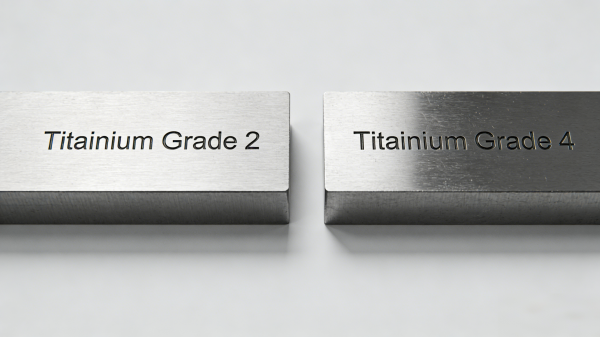
Both Grade 2 and Grade 4 belong to the category of commercially pure (CP) titanium, meaning they are not alloyed with elements like aluminum or vanadium.
The key difference lies in oxygen content:
Grade 2: Moderate oxygen content (~0.25%)
Grade 4: Higher oxygen content (~0.40%)
Oxygen acts as a strengthening element in titanium, which is why Grade 4 is significantly stronger than Grade 2.
Core Differences at a Glance
Property | Grade 2 Titanium | Grade 4 Titanium |
|---|---|---|
Tensile Strength | ~345 MPa | ~550 MPa |
Yield Strength | ~275 MPa | ~480 MPa |
Ductility | High | Moderate |
Hardness | Lower | Higher |
Corrosion Resistance | Excellent | Excellent |
Biocompatibility | Excellent | Excellent |
Machinability | Easier | More difficult |
Cost | Lower | Higher |
At a basic level:
Grade 2 = flexibility + formability
Grade 4 = strength + durability
But the real decision-making goes deeper.
Mechanical Performance: Strength vs Workability
Why Grade 4 Is Stronger
The higher oxygen content in Grade 4 increases:
Tensile strength
Yield strength
Fatigue resistance
This makes it ideal for load-bearing applications, especially where structural integrity is critical.
Where Grade 2 Still Wins
Despite lower strength, Grade 2 offers:
Better ductility
Superior formability
Easier welding and machining
This makes it more suitable for:
Complex geometries
Thin-walled components
Applications requiring frequent forming
Practical Insight
Many buyers assume “stronger is always better.” In reality:
Over-specifying Grade 4 can increase cost and machining difficulty unnecessarily
Under-specifying Grade 2 can lead to premature failure in high-stress environments
Corrosion Resistance: Nearly Identical, But Context Matters
Both grades perform exceptionally well due to titanium’s natural oxide layer (TiO₂), which protects against:
Saltwater
Chlorides
Acids
Body fluids
However, in extreme environments:
Grade 4’s higher density and tighter microstructure can offer slightly better long-term stability
In most industrial and medical applications, though, the difference is negligible.
Biocompatibility and Medical Use
Both Grade 2 and Grade 4 are widely used in:
Dental implants
Surgical instruments
Orthopedic components
However, Grade 4 is generally preferred for implants because:
Higher strength supports long-term load-bearing
Better fatigue resistance reduces failure risk
That’s why many implant systems globally rely heavily on Grade 4 titanium.
Manufacturing Considerations
Machining
Grade 2: Easier to machine, less tool wear
Grade 4: Harder, requires more precise tooling and slower speeds
Forming
Grade 2 excels in cold forming and bending
Grade 4 is more limited and may require heat treatment
Welding
Both grades are weldable, but:
Grade 2 offers more forgiving welding behavior
Grade 4 requires tighter control of shielding and heat input
Supply Chain Insight
For OEM buyers, these differences translate into:
Production lead time
Tooling costs
Scrap rates
A reliable manufacturer will often guide customers toward the most cost-efficient grade—not just the strongest one.
Applications: Where Each Grade Excels
Typical Grade 2 Applications
Chemical processing equipment
Heat exchangers
Marine components
Industrial piping
Sheet metal fabrication
Typical Grade 4 Applications
Dental implants
Surgical implants
Aerospace fasteners
High-strength structural components
A Deeper Perspective: Microstructure and Performance Stability
One often overlooked aspect is microstructural consistency.
Grade 4’s higher oxygen content results in:
Increased lattice distortion
Higher strength but reduced plasticity
This means:
It performs better under repeated stress (fatigue)
But is less forgiving under sudden deformation
For precision applications like dental implants, microstructural stability matters as much as strength.
Cost vs Value: A Strategic Decision
From a purchasing perspective:
Grade 2 is more economical
Grade 4 is higher-performing but more expensive
However, total cost is not just material price:
Machining cost (higher for Grade 4)
Tool wear
Failure risk
Lifecycle cost
Key Insight
For many B2B buyers, the best approach is:
“Use Grade 4 where strength is critical, and Grade 2 where manufacturability and cost efficiency matter.”
How Leading Manufacturers Approach This Choice
Experienced titanium manufacturers don’t simply supply material—they help optimize it.
For example, in real-world OEM collaboration:
Some dental component suppliers selectively use Grade 4 for implant bodies
While using Grade 2 for auxiliary components
This hybrid strategy balances:
Performance
Cost
Manufacturability
Manufacturers with strong process control (such as precision-focused suppliers like SUNXIN) often provide:
Tight tolerance machining
Consistent grain structure
Reliable batch traceability
These factors can matter more than the grade itself in high-end applications.
Common Mistakes Buyers Make
1. Choosing Grade 4 “just to be safe”
→ Leads to unnecessary cost and machining complexity
2. Ignoring manufacturing limitations
→ Designs that work on paper but fail in production
3. Overlooking supplier capability
→ Inconsistent quality even with the right material
FAQ: Titanium Grade 2 vs Grade 4
1. Is Grade 4 always better than Grade 2?
No. Grade 4 is stronger, but Grade 2 is easier to process and often more cost-effective. The “better” choice depends on application requirements.
2. Why is Grade 4 preferred in dental implants?
Because it offers:
Higher strength
Better fatigue resistance
Long-term reliability under chewing forces
3. Can Grade 2 replace Grade 4 in medical applications?
In non-load-bearing components, yes. But for critical implants, Grade 4 is usually required.
4. Is corrosion resistance different between the two?
Not significantly. Both offer excellent corrosion resistance in most environments.
5. Which grade is easier to machine?
Grade 2. It reduces tool wear and machining time.
6. How do I choose the right grade for my project?
Consider:
Load requirements
Geometry complexity
Manufacturing method
Cost constraints
Final Thoughts
The difference between Titanium Grade 2 and Grade 4 is not just about strength—it’s about fit-for-purpose engineering.
Choose Grade 2 when flexibility, manufacturability, and cost efficiency are priorities
Choose Grade 4 when strength, fatigue resistance, and long-term reliability are critical
For B2B buyers, the smartest approach is not simply selecting a grade, but working with a supplier who understands:
Material behavior
Manufacturing constraints
Application-specific performance
Because in practice, the right material is only as good as how well it is processed.