
In the world of medical manufacturing, choosing the right implant material is not just a technical decision—it is a strategic one. For OEM manufacturers, distributors, and medical brands, the choice between 316LVM stainless steel and Ti-6Al-4V titanium alloy directly impacts product performance, regulatory approval, long-term reliability, and ultimately market competitiveness.
Both materials are widely used and well-established in implant manufacturing. However, they are fundamentally different in terms of biocompatibility, mechanical behavior, corrosion resistance, and cost structure. Understanding these differences at a deeper level is essential—not just for engineers, but also for procurement teams and business decision-makers.
This guide goes beyond surface-level comparisons. It explores the real-world performance trade-offs, application-specific advantages, and how to select the right material based on your product strategy.
Understanding the Materials
What is 316LVM?
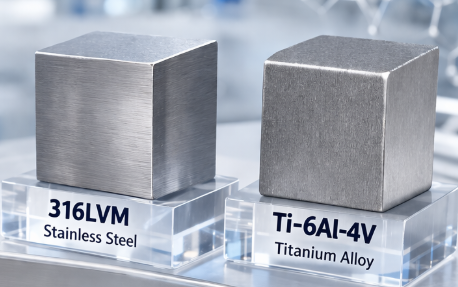
316LVM (Low Carbon Vacuum Melted) is a high-purity version of 316L stainless steel. The vacuum melting process removes impurities and improves consistency, making it suitable for medical-grade applications.
It is widely used in:
Orthopedic temporary implants
Surgical instruments
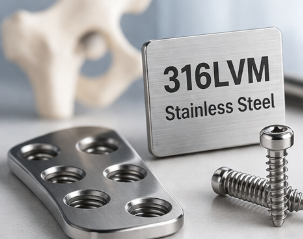
Bone plates and screws
The key advantage of 316LVM lies in its cost-efficiency and ease of manufacturing, which makes it a practical choice for high-volume production.
What is Ti-6Al-4V?
Ti-6Al-4V (Grade 5 or Grade 23 ELI) is a titanium alloy composed of:
6% Aluminum
4% Vanadium
It is the gold standard material for many permanent implants due to its superior properties.
Common applications include:
Dental implants
Spinal implants
Joint replacements
Its popularity stems from its exceptional biocompatibility and strength-to-weight ratio.
Core Differences That Matter
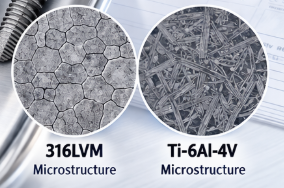
1. Biocompatibility: The Deciding Factor
Biocompatibility determines how well a material interacts with the human body over time.
Ti-6Al-4V clearly outperforms 316LVM in this aspect.
Titanium naturally forms a stable oxide layer that:
Prevents ion release
Promotes osseointegration
Reduces inflammation risk
In contrast, 316LVM contains nickel and chromium, which:
May cause allergic reactions in sensitive patients
Can release ions over long periods
Insight for B2B buyers:
If your product targets long-term implantation (especially dental or orthopedic), titanium is not just better—it is often expected by the market.
2. Corrosion Resistance: Long-Term Stability
Implants operate in a harsh environment: body fluids rich in chloride ions.
Ti-6Al-4V: Exceptional resistance to corrosion
316LVM: Good resistance, but susceptible to pitting and crevice corrosion over time
This difference becomes critical in:
Long-term implants
High-moisture environments (oral cavity)
Even small corrosion effects can compromise structural integrity and release metallic ions.
3. Mechanical Strength vs Elastic Modulus
Here’s where things get interesting.
Strength
Ti-6Al-4V: Higher tensile strength
316LVM: Moderate strength
Elastic Modulus (Stiffness)
Ti-6Al-4V: ~110 GPa
316LVM: ~190 GPa
At first glance, higher stiffness may seem better—but in implants, it often isn’t.
Why?
A high elastic modulus can cause stress shielding, where the implant takes too much load and the surrounding bone weakens.
Titanium’s lower modulus is closer to human bone, which:
Improves load sharing
Supports long-term bone health
4. Weight and Patient Comfort
Titanium is about 45% lighter than stainless steel.
This matters more than many assume:
Improved patient comfort
Easier handling for surgeons
Reduced fatigue in large implants
In dental and orthopedic implants, this becomes a noticeable advantage.
5. Manufacturing and Machinability
This is where 316LVM shines.
316LVM advantages:
Easier to machine
Lower tool wear
Faster production cycles
Ti-6Al-4V challenges:
Difficult machining
Higher tool wear
Requires advanced CNC expertise
However, experienced manufacturers with optimized processes can overcome these challenges.
Industry insight:
Leading implant suppliers increasingly invest in titanium machining capabilities because the market demand justifies the higher production cost.
6. Cost Considerations
Cost is often the biggest deciding factor for B2B buyers.
Factor | 316LVM | Ti-6Al-4V |
|---|---|---|
Raw material cost | Lower | Higher |
Machining cost | Lower | Higher |
Overall cost | Budget-friendly | Premium |
However, focusing only on upfront cost can be misleading.
Total value includes:
Longevity
Failure rate
Brand positioning
Regulatory acceptance
In many premium markets, titanium implants command higher margins and stronger brand trust.
Application-Based Material Selection
When 316LVM is the Better Choice
316LVM is ideal for:
Temporary implants
Cost-sensitive markets
Instruments and tools
Non-load-bearing applications
It remains a reliable and economical solution when long-term implantation is not required.
When Ti-6Al-4V is the Better Choice
Titanium is the preferred option for:
Dental implants
Long-term orthopedic implants
High-performance medical devices
Premium product lines
If your goal is to compete in high-end markets, titanium is often the only viable choice.
The Market Trend: Why Titanium Is Winning
Globally, the implant market is shifting toward titanium alloys.
Key drivers include:
Increasing demand for long-term solutions
Rising patient awareness
Stricter regulatory requirements
Growth of dental implantology
Titanium is no longer just a premium option—it is becoming the industry standard for many applications.
A Practical Perspective for OEM Buyers
From a manufacturing standpoint, the decision is rarely binary.
Many successful product lines use a dual-material strategy:
This allows companies to:
Cover multiple price segments
Optimize production costs
Expand global market reach
Where Manufacturing Quality Makes the Difference
Material selection is only part of the equation.
Even the best material can underperform if:
Surface treatment is inadequate
Machining precision is poor
Quality control is inconsistent
This is where experienced manufacturers play a critical role.
For example, suppliers with strong capabilities in:
Precision CNC machining
Surface modification (such as sandblasting and acid etching)
Strict material traceability
can significantly enhance implant performance—regardless of the base material.
In practice, many OEM buyers are increasingly prioritizing manufacturing reliability over material alone.
Subtle Industry Insight: Why Buyers Are Re-evaluating Suppliers
In recent years, more distributors and medical brands are shifting away from purely price-driven sourcing.
Instead, they focus on:
Stable quality
Certification readiness
Engineering support
Scalability
Manufacturers that can provide consistent titanium and stainless steel solutions under one roof are gaining a competitive advantage.
Companies like SUNXIN, for instance, are often considered by buyers not just for pricing, but for their ability to:
Handle complex titanium machining
Maintain consistent batch quality
Support OEM customization
These factors are increasingly critical in long-term partnerships.
FAQ: 316LVM vs Ti-6Al-4V
1. Is titanium always better than 316LVM?
Not always. Titanium is superior for long-term implants, but 316LVM remains a cost-effective and reliable choice for temporary or non-critical applications.
2. Why is Ti-6Al-4V widely used in dental implants?
Because of its excellent:
Biocompatibility
Osseointegration ability
Corrosion resistance
These properties are essential for implants that integrate with bone.
3. Does 316LVM rust inside the body?
Not exactly “rust,” but it can experience localized corrosion over time, especially in chloride-rich environments like the human body.
4. Which material is easier to manufacture?
316LVM is significantly easier and cheaper to machine, making it suitable for high-volume production.
5. Is titanium worth the higher cost?
In most long-term implant applications, yes. The improved performance, durability, and market acceptance often justify the higher cost.
6. Can both materials be used in the same product line?
Yes, and many successful brands adopt this strategy to target different market segments.
Final Verdict: Which Material Should You Choose?
There is no one-size-fits-all answer.
Choose 316LVM if your priority is cost-efficiency and short-term use
Choose Ti-6Al-4V if you need long-term performance and premium positioning
For most modern implant applications—especially in dental and orthopedic fields—Ti-6Al-4V is the future.
However, the smartest strategy is not choosing one over the other, but understanding when and how to use each effectively.
Closing Insight
In today’s competitive implant market, success is no longer determined by material choice alone. It depends on how well that material is processed, engineered, and delivered to meet real clinical demands.
Manufacturers that combine advanced material expertise with precision production capabilities are becoming the preferred partners for global OEM buyers.
And ultimately, that is where the real differentiation lies.