
Introduction
In the world of high-performance stainless steels, few comparisons are as frequently misunderstood—and as commercially critical—as 420 vs 440C stainless steel. Both belong to the martensitic stainless steel family, both offer corrosion resistance and hardness, and both are widely used across industries such as medical devices, cutting tools, and industrial components.
Yet, beneath these similarities lies a set of critical differences that can directly impact product lifespan, machining efficiency, cost structure, and ultimately, customer satisfaction.
For manufacturers, OEM buyers, and engineering teams, choosing between 420 and 440C is not simply about “better or worse”—it’s about fit-for-purpose material engineering.
This guide goes far beyond surface-level comparisons. We will explore:
Metallurgical differences
Mechanical performance under real-world conditions
Manufacturing implications
Application-specific recommendations
Practical sourcing insights
Understanding the Basics: What Are 420 and 440C Stainless Steels?
Both 420 and 440C belong to martensitic stainless steels, meaning they can be heat-treated to achieve high hardness.
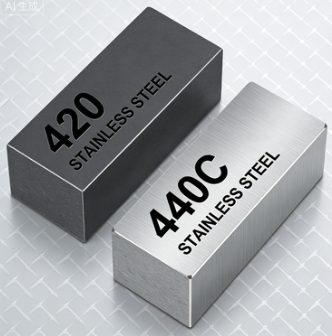
420 Stainless Steel (A/B/C Variants)
420 stainless steel is a low-to-medium carbon martensitic steel, typically categorized into:
420A (lowest carbon, best corrosion resistance)
420B
420C (higher carbon, better hardness)
Typical Composition:
Carbon: 0.15–0.40%
Chromium: 12–14%
420 is known for:
Good corrosion resistance
Moderate hardness
Excellent polishability
Cost-effectiveness
440C Stainless Steel
440C is a high-carbon martensitic stainless steel, often considered the premium version within the 440 series.
Typical Composition:
Carbon: 0.95–1.20%
Chromium: 16–18%
440C is known for:
Exceptional hardness
Superior wear resistance
Good corrosion resistance (but less than austenitic steels)
High strength under stress
Core Difference: Carbon Content Drives Everything
The most important distinction between 420 and 440C is carbon content.
Higher carbon = higher hardness potential
But also = reduced corrosion resistance and machinability
This creates a fundamental trade-off:
Property | 420 Stainless Steel | 440C Stainless Steel |
|---|---|---|
Carbon Content | Low–Medium | High |
Hardness | Moderate | Very High |
Corrosion Resistance | Better | Slightly Lower |
Wear Resistance | Moderate | Excellent |
Machinability | Better | More Difficult |
Cost | Lower | Higher |
Mechanical Properties in Real Applications
Hardness
This difference is substantial.
In applications like:
Surgical tools
Bearings
Cutting blades
440C maintains sharpness and dimensional integrity far longer.
Wear Resistance
Wear resistance is where 440C clearly dominates.
Because of its higher carbon content, it forms more carbides:
Improves abrasion resistance
Extends service life in high-friction environments
Practical Insight:
420 = suitable for moderate wear
440C = preferred for continuous or high-load wear
Corrosion Resistance
Interestingly, 420 can outperform 440C in certain environments.
Why?
Lower carbon means fewer chromium carbides
More free chromium remains for corrosion protection
Conclusion:
420 performs better in humid, mildly corrosive environments
440C is sufficient but not optimal for highly corrosive conditions
Manufacturing Considerations
Machinability
420: Easier to machine, lower tool wear
440C: Harder to machine, requires advanced tooling
For high-volume production, this directly affects:
Tooling cost
Cycle time
Yield rate
Many experienced manufacturers (including those working with advanced alloys like SUNXIN) optimize production by:
Pre-machining in annealed condition
Applying controlled heat treatment
Using precision grinding post-hardening
Heat Treatment Sensitivity
440C requires tighter process control:
Precise quenching
Controlled tempering
Improper handling can result in:
Brittleness
Cracking
Distortion
420, on the other hand, is more forgiving.
Surface Finish
420 offers excellent polishability, making it ideal for:
Medical instruments
Mirror-finish components
440C can also be polished, but:
Requires more effort
Higher cost to achieve the same finish
Application-Based Comparison
When to Choose 420 Stainless Steel
420 is ideal for:
Medical instruments (non-critical wear)
Valve components
Pump shafts
Plastic molds
Kitchen tools
Why?
Balanced corrosion resistance
Lower cost
Easier processing
When to Choose 440C Stainless Steel
440C excels in:
Surgical cutting tools
Bearings
High-end knives
Precision mechanical components
Dental tools requiring wear resistance
Why?
Maximum hardness
Long-term dimensional stability
Superior wear resistance
Cost vs Performance: A Strategic Decision
From a procurement perspective, the choice is often about total lifecycle cost, not raw material price.
420:
Lower upfront cost
Lower processing cost
Shorter lifespan in high-wear applications
440C:
Higher material cost
Higher machining cost
Longer service life
Key Insight for B2B Buyers:
In high-precision industries, 440C often delivers lower total cost of ownership, despite higher initial investment.
Industry Insight: Why Many Manufacturers Use Both
Advanced manufacturers rarely rely on a single material.
Instead, they:
Use 420 for structural or low-wear components
Use 440C for critical wear parts
Material selection becomes part of engineering optimization, not just procurement.
This is also where experienced suppliers—such as those with deep metallurgical expertise like SUNXIN—can provide value beyond raw material supply, helping clients match alloy selection to real-world performance needs.
Emerging Trends in Material Selection
Modern industries are shifting toward:
Hybrid material strategies
Precision heat treatment optimization
Application-specific alloy customization
In this context:
420 is evolving with modified grades (e.g., 420Mod)
440C remains a benchmark for wear resistance
Manufacturers that understand these nuances gain a competitive edge in product performance and cost efficiency.
FAQ: 420 vs 440C Stainless Steel
1. Is 440C always better than 420?
No. 440C is better for wear resistance and hardness, but 420 is better for:
Corrosion resistance (in some environments)
Machinability
Cost-sensitive projects
2. Which is better for medical applications?
It depends:
420: General surgical instruments
440C: Cutting tools, high-wear components
3. Is 440C more brittle?
Yes, compared to 420:
Higher hardness = lower toughness
Requires precise heat treatment
4. Which is easier to machine?
420 is significantly easier to machine, making it preferable for:
Complex geometries
High-volume production
5. Can 420 replace 440C to reduce cost?
Only in low-wear applications.
Replacing 440C in high-stress environments may lead to:
Faster wear
Higher maintenance cost
Product failure
6. Which steel holds a sharper edge?
440C, due to:
Higher hardness
Carbide content
Final Verdict: Choosing the Right Steel for the Right Job
There is no universal “winner” between 420 and 440C stainless steel.
Instead:
Choose 420 for:
Cost efficiency
Corrosion resistance
Easier manufacturing
Choose 440C for:
Maximum hardness
Wear resistance
High-performance applications
For B2B buyers, the real advantage lies in partnering with a manufacturer who understands application-driven material selection, rather than simply supplying standard grades.
Conclusion
The comparison between 420 and 440C stainless steel is ultimately a study in engineering trade-offs:
Hardness vs machinability
Wear resistance vs corrosion resistance
Cost vs performance
Understanding these trade-offs allows manufacturers and buyers to make smarter, more profitable decisions.
In a competitive global market, material selection is no longer a technical detail—it is a strategic advantage.